





УЧРЕЖДЕНИЕ ОБРАЗОВАНИЯ «ВИТЕБСКАЯ ГОСУДАРСТВЕННАЯ АКАДЕМИЯ ВЕТЕРИНАРНОЙ МЕДИЦИНЫ» КАФЕДРА ПАРАЗИТОЛОГИИ И ИНВАЗИОННЫХ БОЛЕЗНЕЙ ЖИВОТНЫХ
Добро пожаловать на интернет-страницу кафедры паразитологии и инвазионных болезней животных.
Телефон кафедры: 8 (0212) 33-16-32
Паразитология как наука, основанная на признании единства организма и внешней среды, ставит своей целью оздоровление животных и людей от паразитозов. Начало изучению паразитарных болезней человека и животных положено очень давно. Еще в древние времена египтяне, китайцы, греки знали о клиническом течении некоторых болезней паразитарной этиологии. Изобретение микроскопа, использование в лабораторно-клинической практике различных красок способствовали усовершенствованию диагностики паразитарных болезней.
Будущее способен предвидеть только тот, кто понял прошедшее
Г.В. Плеханов
Ветеринарная паразитология на научной основе начала формироваться в начале 20 века, и ее развитие неразрывно связано с именем академика К.И. Скрябина.
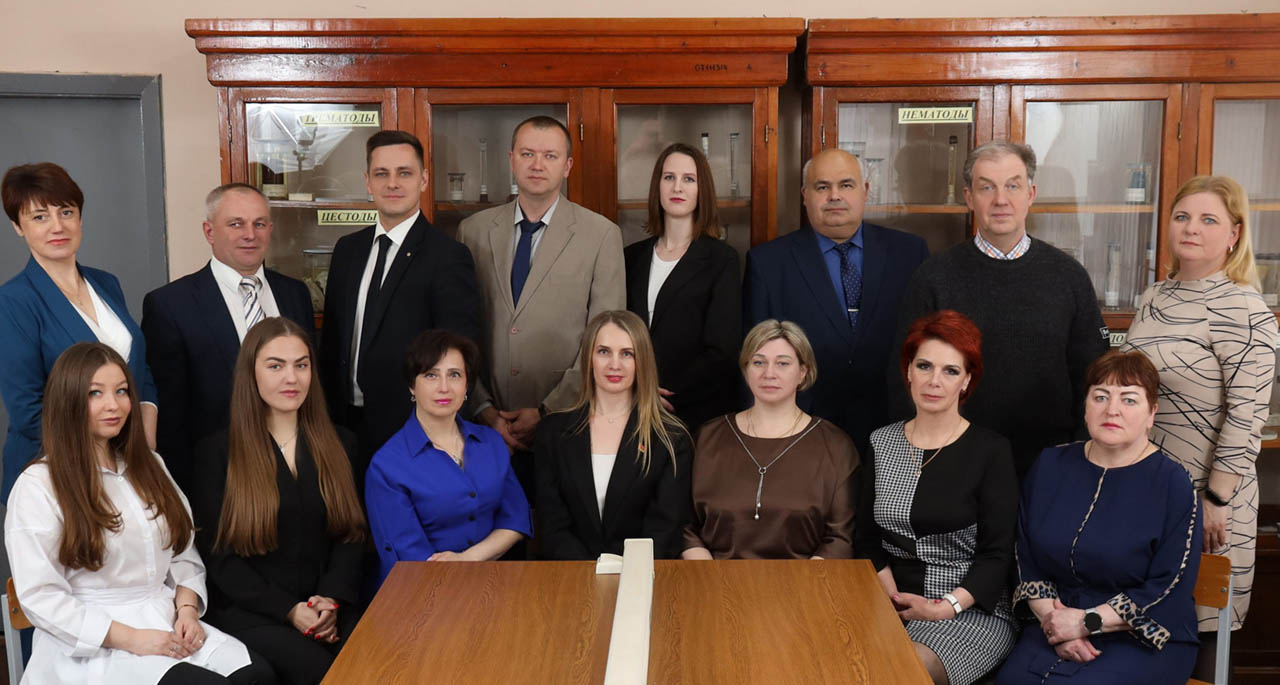
Коллектив кафедры паразитологии в 2026 году (слева направо):
Первый ряд: Е.О. Чупахина, Д.Л. Липская, Е.Б. Криворучко, Е.О. Ковалевская, И.С. Касперович, Н.Г. Хомченко, М.В. Павлова
Второй ряд: А.М. Сарока, И.П. Захарченко, А.В. Соловьев, Н.М. Чубуков, П.Р. Шлыкова, Ю.А. Бородин, С.С. Цвырко, М.В. Старовойтова
Department of Parasitology
Department of Parasitology with course of Zoology was founded at the Institute in 1927. Among the first of its heads was Shcherbovich Iosif Antonovich.
Since 1990 the Department is headed by academician of the Petrovskaya Academy of Sciences and arts, Academy of agrarian education (Russia), academician of International Academy of information technology, honored worker of science of the Republic of Belarus, Yatusevich Anton Ivanovich.
The Department has unique equipment and a large set of Museum visual material’s: 691 mikropreparations and 4925 macropreparations specimens, which allows almost all the themes to work, having a natural visual aid.
The department trains students of the Faculty of Veterinary Medicine and the Biotechnological Faculty and the (full-time and correspondence studies). Veterinarians, heads of agricultural enterprises, college teachers, teachers of agricultural universities of the country develop their qualification and improve their skills as well.
Computer based technologies are used in the educational process.
The department is engaged in extensive educational and methodical work, providing the learning process with the necessary documentation: computer programs, manuals and students’ guides etc.
There is a student scientific society at the department. Scientific work of students is part of diploma works.
The department also carries out intensive research work.
In addition to the educational process, the Department conducts intensive research work. Scientists of the Department published more than 70 monographs and textbooks, prepared and defended 9 doctoral and 29 master’s theses, published more than 2,000 scientific articles, approved, 95 inventions and rationalization proposals, prepared and implemented in agricultural production 60 methodological developments, guidelines and recommendations developed over 50 new antiparasitic drugs.
The Department established a private clinic that provides services for the diagnosis, prevention and treatment of all types of farm and domestic animals using the latest techniques and developments in veterinary practice. Qualitative diagnostics of parasitoses can promptly and efficiently provide medical assistance in the early stages of the disease. This gives you the opportunity to prevent possible danger to the health of a pet and its owner, because some parasites pose a serious threat to humans.
Members of the Department strive not only to maintain but also to develop scientific tradition, long experience of teaching and educational work with students, improving the educational process, improving the quality of training veterinary specialists.